Showing posts with label helpful things. Show all posts

Tuesday, December 1, 2015

internet favorites for december: the only apps i've ever loved

As a rule, I dislike trying out apps or downloading things. Technology-wise, I am a late adapter. But these three apps have made themselves essential to my life, and I wholeheartedly recommend them!

1. Unroll.me
Eve showed me this. It combines all the subscriptions you choose (how about some Madewell promo emails? Everlane? Bookcourt?) into one single email, and sends it to you every morning. It has saved my inbox!

2. VSCO Cam
I know this is old news for smartphone owners, but this is an awesome app for photo-editing on your phone--more subtle filters than Instagram, and lots of fine-tuneable options.

3. Camerabag 2
I can't afford Photoshop or even Lightroom, and this $20 thingy allows me to edit my digital photos to the extent that I want. And it's been invaluable for my Fusion freelancing. I love it! It's like VSCO Cam for a desktop, but with even more options. And if all your images from an event have the same problem--like, they're all too yellow--you can create your own filter and save it.


PS Here are the other internet favorites.

Monday, August 10, 2015

Recent Favorite Books, Part 5

Here are all the recent favorite books, and here are some from my summer reading regimen, which, evidently, is "Women + Sebald."


The Wallcreeper by Nell Zink
"Now, in town, you never know whether the neighbors are home. Even in the backcountry of Yosemite, there are those other people with a pass. Nearly anywhere you go, someone might hear or see you. But not on a levee by the Elbe two miles from the nearest town in dense fog at six o'clock on a Sunday morning in September. They say in space no one can hear you scream, but why would a person with a sense of dignity scream anywhere else?" (93)


The Rings of Saturn by W. G. Sebald
"This then, I thought, as I looked round about me, is the representation of history. It requires a falsification of perspective. We, the survivors, see everything from above, see everything at once, and still we do not know how it was. The  desolate field extends all around where once fifty thousand soldiers and ten thousand horses met their end within a few hours. The night after the battle, the air must have been filled with death rattles and groans. Now there is nothing but the silent brown soil. Whatever became of the corpses and mortal remains? Are they buried under the memorial? Are we standing on a mountain of death? Is that our ultimate vantage point? Does one really have the much-vaunted historical overview from such a position?" (125)


 from the museum about dunwich in orford...


The Emigrants by W. G. Sebald
"When I wake up, I see the jars of preserves ranged on the chest and in the cold compartments of the tiled stove. I try in vain to work out what they mean. They don't mean anything, says Mama, they're just cherries, plums and pears." (206)


The Folded Clock: A Diary by Heidi Julavits
"I am no longer immune, however, to the occasional plummet in time altitude. A plummet happened the other night. I found myself lying in bed and thinking about Mexican wineglasses, the green kind with the air bubbles. They are the size of goblets. I'd put a lot of identity stock, at one time in my life, in Mexican wineglasses. I'd bought some in my twenties, and they represented a pinnacle achievement in self-realization. Thinking of these wineglasses reminded me of a trip I'd taken through Mexico with a boyfriend when we were both in our twenties; we'd driven a two-piston rental through mountain ruts. We slept in fields. We emerged in a town with white walls and cafés, and were there also Mexican wineglasses? Did I buy mine there? I don't think so. I only remember a photo I took in that town of a white adobe wall and, rising above it, a crucifix atop a church dome. I was not religious, yet the photograph was so religious that I felt I shouldn't or couldn't be as fond of it as I was. But now, lying in bed and thinking about wineglasses, I found myself thinking of this photo, and the girl who took it, and the town--I'll never know its name--and I felt the kind of longing for that girl/town/photo I feel for my children at night when they are asleep." (59)


H is for Hawk by Helen Macdonald
"And then, with a slow, luxuriant thrill, I realized that everything was different about the house I was in. It was the hawk. I shut my eyes. The hawk had filled the house with wildness as a bowl of lilies fills a house with scent." (65)


And, the best for last (I went crazy for this book, which I found much more satisfying than Bluets).


The Argonauts by Maggie Nelson
"If you're looking for sexual tidbits as a female child, and the only ones that present themselves depict child rape or other violations (my favorite books in my preteen years: I Know Why the Caged Bird Sings, Clan of the Cave Bear, The World According to Garp, as well as the few R-rated movies I was allowed to see--Fame, most notably, with its indelible scene of Irene Cara being asked to take her shirt off and suck her thumb by a skeezy photographer who promises to make her a star), then your sexuality will form around that fact. There is no control group. I don't even want to talk about "female sexuality" until there is a control group. And there never will be." (66)

"But whatever I am, or have since become, I know now that slipperiness isn't all of it. I know now that a studied evasiveness has its own limitations, its own ways of inhibiting certain forms of happiness and pleasure. The pleasure of abiding. The pleasure of insistence, of persistence. The pleasure of obligation, the pleasure of dependency. The pleasures of ordinary devotion. The pleasure of recognizing that one may have to undergo the same realizations, write the same notes in the margin, return to the same themes in one's work, relearn the same emotional truths, write the same book over and over again--not because one is stupid or obstinate or incapable of change, but because such revisitations constitute a life." (112)

Wednesday, September 10, 2014

Some amazing books I've been flipping out about recently

 See Parts 1 and 2.

(Not in order of goodness. They are all amazing.)


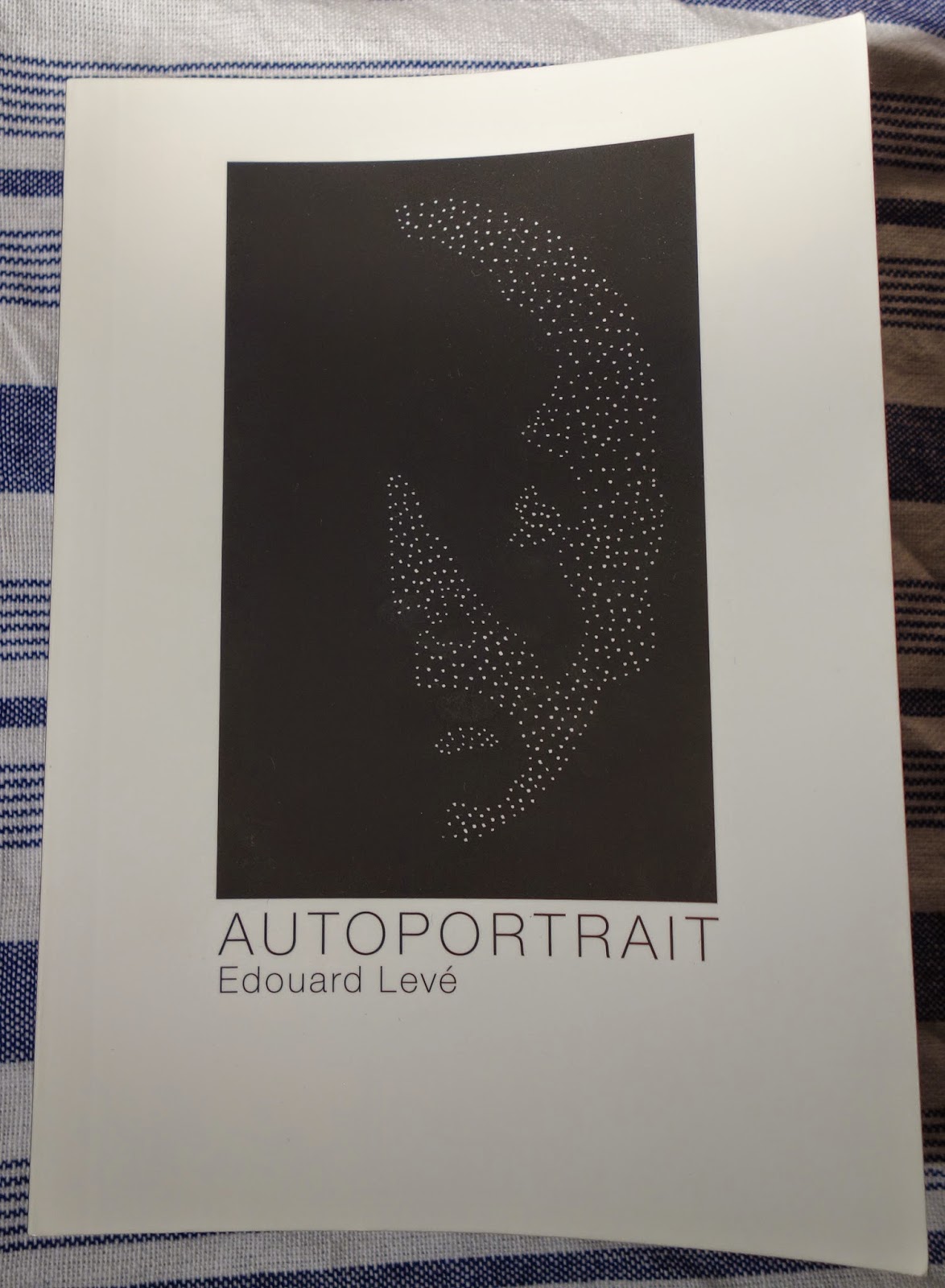
1. Autoportrait, Edouard Levé (Dalkey Archive)
A collection of pin-sharp autobiographical nonsequiturs.

"To me the smell of manure recalls a bygone era, whereas the smell of wet earth evokes no particular time."
"Other people's failures make me sadder than my own."
"I am happy to be happy, I am sad to be sad, but I can also be happy to be sad and sad to be happy."


2. Women in Clothes, Sheila Heti, Heidi Julavits, Leanne Shapton and 639 Others (Blue Rider Press)
A book full of discussions with a huge variety of women (a bit cis, I acknowledge) about clothes, identity, admiration, rules, and obsessions.

"Joss Lake: My ex-girlfriend said, 'You don't have style, you have styles.' I'd always felt like I was failing to construct a coherent style--so it became a sort of Whitmanian mantra, not only for fashion, but for my personhood: 'I contain multitudes. I contain multitudes.'"
"Szilvia Molnar: I love noticing women who have a panoramic view of their environment when they're walking down the street. Women who are engaged in the moment and are interested in looking at who or what is around them."


3. Are You My Mother?, Alison Bechdel (Mariner)
A graphic memoir focused on Bechdel's relationship with her mother, plus psychoanalysis, Virginia Woolf, dreams, sex--makes me excited to notice more of the coincidences and thematic ties between all areas of life.


4. 10:04, Ben Lerner (Faber and Faber)
A beautiful New York book that is as helpful/transformative as a sustained conversation with a really smart friend (I already sought out the recommended Soho Crate & Barrel bathroom and it was great), closely observing those moments when life feels different and strange.

"And so on: each of these experiences of reception remained, as it were, in situ, so that whenever I returned to a zone where significant news had been received, I discovered that the news and an echo of its attendant affect still awaited me like a curtain of beads."


5. The Revolution Will Not be Microwaved: Inside America's Underground Food Movements, Sandor Ellix Katz (Chelsea Green)
From slow food to roadkill.

"I tend to be very adventurous about tasting plants I don't know; my rule of thumb is that it's okay to taste unknown plants (though not fungi) so long as you experiment slowly. Smell before you taste. Taste just a tiny bit. Chew it well, mix it with saliva, and see how it feels in your mouth. If it tastes unpleasant or you start reacting in some strange way, spit it out and don't eat any more. If it feels okay in your mouth, swallow."

Wednesday, April 2, 2014

Recent favorite books (Part 2)


1. Leaving the Atocha Station, Ben Lerner (Coffee House Press)
 "During this period [of rain and boredom] all like periods of my life were called forth to form a continuum, or at least a constellation, and so, far from forming the bland connective tissue between more eventful times, those times themselves became mere ligaments. Not the little lyric miracles and luminous branching injuries, but the other thing, whatever it was, was life, and was falsified by any way of talking or writing or thinking that emphasized sharply localized occurrences in time. But this was true only for the duration of one of these seemingly durationless periods; figure and ground could be reversed, and when one was in the midst of some new intensity, kiss or concussion, one was suddenly composed exclusively of such moments, burning always with this hard, gemlike flame."


2. The Art of the Commonplace, Wendell Berry (Counterpoint)
"Occasionally one stumbles into a coincidence that, like an unexpected alignment of windows, momentarily cancels out the sense of historical whereabouts, giving with an overwhelming immediacy an awareness of the reality of the past.
"The possibility of this awareness is always immanent in old homesites. It may suddenly bear in upon one at the sight of old orchard trees standing in the dooryard of a house now filled with baled hay. It came to me when I looked out the attic window of a disintegrating log house and saw a far view of the cleared ridges with wooded hollows in between, and nothing in sight to reveal the date. Who was I, leaning to the window? When?"


3. Art as Experience, John Dewey (Perigee)
"The man who poked the sticks of burning wood would say he did it to make the fire burn better; but he is none the less fascinated by the colorful drama of change enacted before his eyes and imaginatively partakes in it. He does not remain a cold spectator."

Sunday, March 30, 2014

Recent favorite books (part 1)


1. Love Dog, Masha Tupitsyn (Penny-Ante)
"Emmanuel Lévinas wrote in 'Peace and Proximity':
'The face as the extreme precariousness of the other...'"


2. I Love Dick, Chris Kraus (Semiotext(e))
"'Because we rejected a certain kind of critical language, people just assumed that we were dumb,' the genius Alice Notley said when I visited her in Paris. Why is female vulnerability still only acceptible when it's neuroticized and personal; when it feeds back on itself? Why do people still not get it when we handle vulnerability like philosophy, at some remove?"


3. Speedboat, Renata Adler (New York Review Books)
"Matthew, the man I had arrived with, was drinking brandies. I was drinking gin. Suddenly, my zabaglione vanished, cream, cup, strawberry, and all. I had a distinct, an eidetic memory of seeing it there before me. It was gone. I looked for it. Matt looked for it. It was nowhere. Somebody's handbag was on the floor beside my chair. I felt that a whole zabaglione could not have fallen, tidily, into a stranger's handbag. I couldn't search in a stranger's handbag, anyway. We stopped thinking about it."


4. Smokehouse Ham, Spoon Bread and Scuppernong Wine: The Folklore and Art of Southern Appalachian Cooking, Joseph E. Dabney (Cumberland House)
"Speaking of interesting old-time fruits with interesting flavors, whatever happened to all the Appalachian pawpaw trees? In days past, pawpaws were found everywhere in the country--on wooded slopes, under bluffs, and along streams. Poet James Whitcomb Riley once described pawpaws as custard pie without a crust. Others have linked their taste to a combination banana, pear, and sweet potato custard or to 'custard apples.' They were used to make puddings, pies, jellies, and pawpaw brandy. Largest in size of native North American fruits--about like a cucumber--the pawpaw was one of the staunch dietary standbys of Appalachian and Amerindian folk in times past."


Thursday, August 29, 2013

Night and its Strange Likeness to a Diego Rivera Mural, by John Rybicki

Amy Hempel assigned this as a reading for our fiction workshop in 2010.


I shadow box the sheet hanging over the opening
             to the back of my house,
tacked up to trap in the heat.

I jab sometimes with knives in each hand
             shredding the sheet before me,
or with a hammer-like swing

to the right stab at the bathroom door.
             A young Mexican man at my gym
beams and asks if I’m training for a fight.

No, just fighting my own demonios.
             He laughs but nods his head yes to this.
Tonight I’m fists against the mattress

propped up against the wall.
             Sometimes I switch to fighting southpaw,
an alien feel.

I’m soldier training for no war
             in an age where the menace
is a field in the brain:

the chess pieces are dunked in flame
             and shuffle about while I blink
and press on from stop light to stop light.

I’m finding the tomahawk again at the tire shop,
             and snapping kicks at my refrigerator
to pass the nights in this ghost house.

Even when I’m bow hunting with the rain
             of red and yellow leaves
that fall like hands all around me,

I wonder has nature finally given
             what my father tried to provide,
slapping the scars all over my skin like medals?

Armor up, boy. The sun may as well
             have brass knuckles
at the ends of its beams.


--John Rybicki